The Columbus Theatre Arts Center Charts its Future
by Drawing from the Past...
 Some
History & background: Some
History & background:
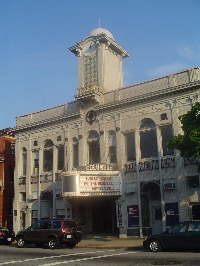
Located at 270 Broadway, the Columbus
Theatre is a jewel in the center of the city of Providence.
Originally built by Domenic Annotti in 1926 and designed
by Oreste Di Saia (best known for designing the popular
Metropolitan Theatre in New York and the Rhode Island’s
Veterans’ Memorial Auditorium), the Columbus has
since seen many changes in its lengthy history.
The Columbus Theatre was aptly named for its 1,492 seats
that the theatre originally had when it opened on November
1, 1926. Domenic Annotti, who built the theatre, operated
the Columbus with RKO specialized in films from that
studio. (During this period, it was renamed the Uptown
Theatre ). Unfortunately, after breaking off the business
relationship with RKO, problems arose in acquiring first
run films. Soon the crowds began to thin. In the 1950’s,
as television gave theatres across the country major
competition, many theaters suffered irreparably and
by 1962, the Columbus Theatre closed.
In the summer of that year, the Berberian family seized
the opportunity to bring opera and music to the Providence
area, and bought the now available theatre. While the
building needed major repairs, the Berberians were able
to reopen it on its 36th anniversary date November 1,
1962. Given Jon (Sarkis) Berberian’s background
with New York City Opera (Jon was a tenor and his wife,
Betty Jane a soprano), it was fitting that the first
presentation was the final concert for world-renowned
tenor, Tito Schipa. Not long afterwards, films returned
to the facility in February of 1963 following the suggestion
of Ed Volante, the head projectionist for the theatre
since 1927.
In between film showings, the Columbus Theatre soon
became a hot spot where celebrity entertainers would
come to perform. These included such luminaries like
Jerry Vale, Al Martino, Lou Monti, George Shearing,
The Four Seasons, Claudio Villa, and Roy Acuff.
Changes to the building and its venue possibilities
were to come following a surprise hit with a little
European film called “The Doll.”
The Berberians decided to build a theatre out of the
balcony in order to successfully show two films at the
same time. This made it possible for them to show a
successful film downstairs while being able to show
a different art or foreign film upstairs. The Columbus
became the first theatre in Rhode Island to convert
to the multiplex concept, long before it became the
norm.
During this time the Berberians were also involved with
bringing in the best live entertainment in the area.
The Columbus Theater then showcased everything from
professional singers and pianists, to actors and other
performers. A little known fact was that the Columbus
also ran an opera series with Wheaton College for 30
years, closing the theatre during the opera runs.
 But
the film business was changing. The studio system had
broken down and film distribution was mired in the changes
affecting Hollywood. A string of big-budget films died
at the box office and an American public seeped in the
turmoil of Vietnam, looked elsewhere for entertainment. But
the film business was changing. The studio system had
broken down and film distribution was mired in the changes
affecting Hollywood. A string of big-budget films died
at the box office and an American public seeped in the
turmoil of Vietnam, looked elsewhere for entertainment.
Given the temper of the times, the Columbus soon saw
harsh competition from other venues as suburban multiplexes
with smaller seating capacity began to take hold. For
a time, the theatre continued to draw crowds for their
feature arthouse and foreign films. Yet, as film product
became more and more difficult to obtain, the family
decided it had to do something in order to keep the
building.
The Berberians made a choice to specialize in the only
product available at the time: adult films. In the early
1970s, adult fare included many mainstream Hollywood
films such as Kubrick’s “A Clockwork Orange,”
Bertolucci’s “Last Tango in Paris,” and
Schlesinger’s “Midnight Cowboy” All were
released with X ratings. Other theatres that entered
the adult market at that time as a means for survival
included the Stadium Theatre in Woonsocket (now newly
restored) and the Rustic Drive-In, which remains the
lone surviving drive-in in the region.
While the theatre’s survival was assured for the
short term, the switch in product had an unintended
price tag which only time would reveal: a stigma first
attached to the film product then ultimately to the
theatre itself.
Things changed for the Columbus in the summer of 2000,
when independent film rediscovered the theatre.
 Ralph
Goudeau, Sara Archambault and Laura Mullen began running
an out of competition film festival called “Picture
Start” on Wednesday evenings in August. These exhibitions
drew a full house for each performance and provided
a platform for alternative and cutting edge work. Ralph
Goudeau, Sara Archambault and Laura Mullen began running
an out of competition film festival called “Picture
Start” on Wednesday evenings in August. These exhibitions
drew a full house for each performance and provided
a platform for alternative and cutting edge work.
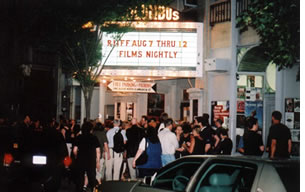
At the same time, the Rhode Island International Film
Festival was looking for a space with a history and
character that would accommodate a screen legend who
would be receiving a Lifetime Achievement Award: Patricia
Neal. It was a perfect match.
RIIFF is the only festival in New
England that is a qualifying festival for the Academy
of Motion Picture Arts and Sciences. (Out of 7,000
festivals worldwide, only 75 festivals are Academy qualifiers.)
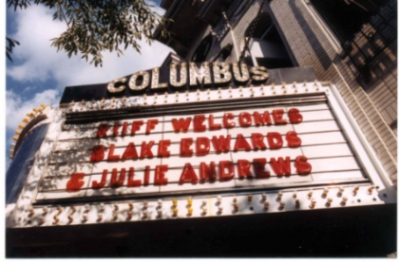
In 2001, not just a screen
legend, but an icon, Julie Andrews was on the Columbus
stage to receive the same award for her husband, Blake
Edwards. In 2002, lines reached around the block for
those attending the film festival. This trend continued until 2009 with the appearance of Ernest Borgnine, Anne Meara, Jerry Stiller and Doris Roberts at RIIFF. In all, the Festival became a "Who's Who" within the industry gracing the stage of the Columbus Thearte.
The Columbus was the "official home" of the Rhode Island
International Film Festival from 2000 until 2009 when it became mired in issues surrounding fire code. Three years and $400,000 later, the Columbus is set to reopen for its next act!
Now it is looking toward that next act. How that plays out has yet to be written. But given its past, the Columbus Theatre will no doubt play a critical role for the arts and its community in the upcoming years.
• See more about the Columbus from their Facebook Page
• See interior shots of the Columbus Theatre by Trig Photography
|